Johanna Leonberger and Wilhelm Leonberger
News of the WorldJohanna Leonberger and Wilhelm Leonberger are joined by blood but estranged by the lives they have led and by their incompatible expectations of what family care requires. Her return to Wilhelm’s farm is presented not as a completed homecoming but as a test of whether a biological relative can make a place for a child who has been shaped by four years among the Kiowa. Wilhelm says he will take her in; the household that follows offers neither the gradual adjustment Jefferson Kyle Kidd urges nor the security Johanna needs. Her eventual choice to leave with Jefferson makes the limits of the uncle’s welcome unmistakable.
Kinship and the return
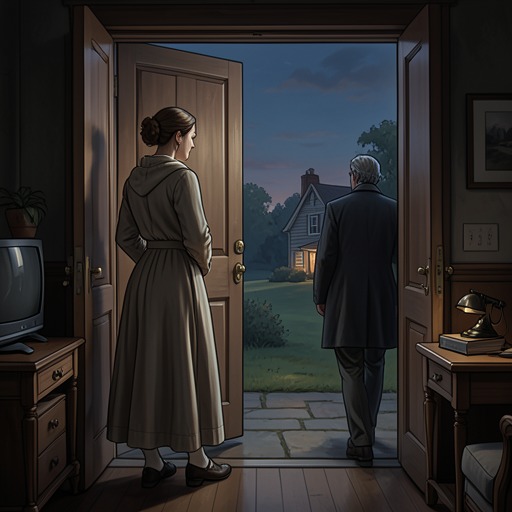
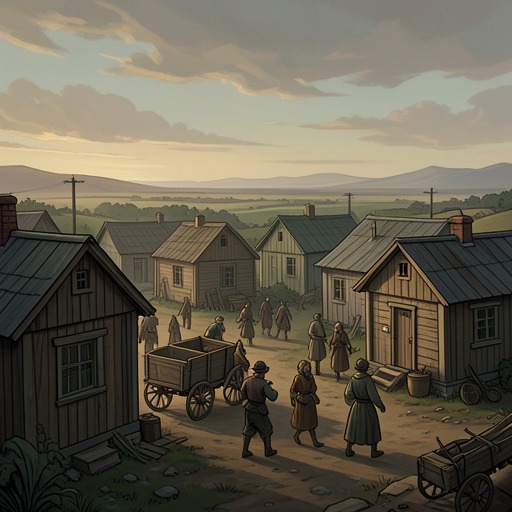
Wilhelm is Johanna’s uncle, and his farm is the destination Jefferson has been trying to reach with her. Before they arrive, Jefferson gives a passerby the news to carry ahead: Johanna, the daughter of Jan and Greta, has been missing for four years and is returning from captivity among the Kiowa. The messenger rides south to announce her return. When Jefferson reaches the farm, the reunion is staged amid ordinary signs of rural life—a stone house and long porch, a paling fence, chickens, tools, a barn, and dogs. Johanna initially appears blank and looks toward the property without moving her head. The German language changes her response: hearing it, she looks around again and recognizes her aunt and uncle.
Jefferson introduces himself to Wilhelm and explains that he has brought back Johanna, ransomed by Indian Agent Samuel Hammond at Fort Sill, Indian Territory north of the Red River. He hands over the papers. Wilhelm reads them while Jefferson waits, tired and in pain after the journey from Wichita Falls on the Red River. Johanna crosses the driver’s seat and climbs down beside him. Her return therefore begins with a transfer of responsibility as much as a family recognition: Jefferson supplies the documents and the history of her recovery, while Wilhelm must decide what his kinship will mean in practice.
A welcome at odds with her needs
Jefferson understands that return cannot simply reverse captivity. He tells Wilhelm that Johanna thinks of herself as Kiowa and needs quiet, peace, gradual adjustment, and reassurance after changing guardians three times. Yet he also anticipates that news of her return will spread and draw people who will arrive with songs, food, family photographs, and a dress from her childhood, urging her to remember. The anticipated welcome is full of affection and excitement, but its insistence on recovering the child she was risks overlooking the child who has come back.
Inside the house, that difference becomes visible. Johanna sits on her haunches in a corner, holding her ankles and staring at objects unfamiliar to her: daguerreotypes, doilies, bright carpet, dishes, side tables, and curtains covering windows set into stone walls. The room is not merely strange decoration; it is a domestic world whose habits and meanings she does not share. Anna tells her to get up, but Johanna stays on the floor. Later she sings softly in Kiowa while the adults discuss whether she is glad to have returned. Her song preserves an affiliation that the household treats as something to be corrected rather than as part of her present identity.
Work, custom, and legal obligation
Wilhelm says Johanna must learn to work and to live by the family’s ways. He explains that they have no children, apart from a nephew working at an Englishman’s cattle establishment in Frio Town, and that Anna needs help because there is much work to do. Anna likewise insists that Johanna is not too small to do her share. Jefferson stresses that she is only ten and asks the adults to take her circumstances into account. Their disagreement is not simply about whether she belongs in the household: Wilhelm offers a place, but frames that place through labor and adaptation, while Jefferson emphasizes her age and the need for patient care.
The question of formal adoption sharpens the difference between kinship and responsibility. Wilhelm asks whether Jefferson has a receipt for the wagon, though Jefferson has none. Later, Jefferson raises the fact that Johanna has no adoption papers. A messenger explains that the family is unlikely to adopt her because adoption would legally oblige them to support her and, according to custom, provide a dowry; they did not adopt their nephew either. The exchange gives the household’s welcome a material and legal boundary. Wilhelm has accepted his niece into the farm, but there is no formal commitment ensuring her support, and the messenger warns Jefferson that he cannot leave her there.
The departure from Wilhelm’s farm
Jefferson leaves, but returns that night, uncertain whether the family might already be glad to be rid of Johanna. From beside a grove of mesquite, he sees her alone in a field, sent out after dark to fetch the horses. She carries a wooden bucket of shelled corn and several heavy leather halters; the load makes her stagger across unfamiliar ground. She calls softly to the horses in Kiowa. The task brings together the household’s demand that she work and the continuing cultural separation between her and its expectations: even in her uncle’s care, she reaches for the language of the life from which she was taken.
When Jefferson calls, Johanna stops and looks toward the wagon. He sees dark red stripes on her forearms and hands from a dog whip. He tells her they are leaving and to drop the bucket. Johanna runs to the fence, vaults it, and says in Kiowa that she will go with her grandfather. Crying, she repeats her decision. Jefferson puts an arm around her, throws the halters into the road, and turns the Curative Waters wagon north. Her actions, not an argument between the adults, settle the relationship: Wilhelm’s offer has not become a home she can accept, while the bond she has formed with Jefferson is strong enough for her to choose his company again.
The meaning of their estrangement
The separation does not make Wilhelm a stranger in the literal sense; it reveals how little blood relation alone can resolve after a child’s long absence. Johanna can recognize her uncle and aunt, yet recognition does not restore a shared childhood, language, or domestic rhythm. Wilhelm’s stated intention to take her in coexists with expectations of work, European behavior, and a household arrangement without formal adoption. Johanna’s return thus exposes the difference between receiving a relative and understanding what that relative has become.
The contrast with other offers of care makes that failure more pointed. Earlier, Doris Dillon responds to the news that Johanna is German by offering to take her, explaining that the child resembles her dead little sister. Wilhelm, by contrast, has a blood claim but describes the practical help he expects from Johanna. Jefferson’s decision to return is driven by what he sees in the field: a ten-year-old carrying a heavy load after dark, with whip marks on her arms. Johanna’s departure turns the reunion into a refusal of an inadequate settlement. The relationship ends not with reconciliation but with a second separation, chosen by the child whose needs the reunion was supposed to answer.